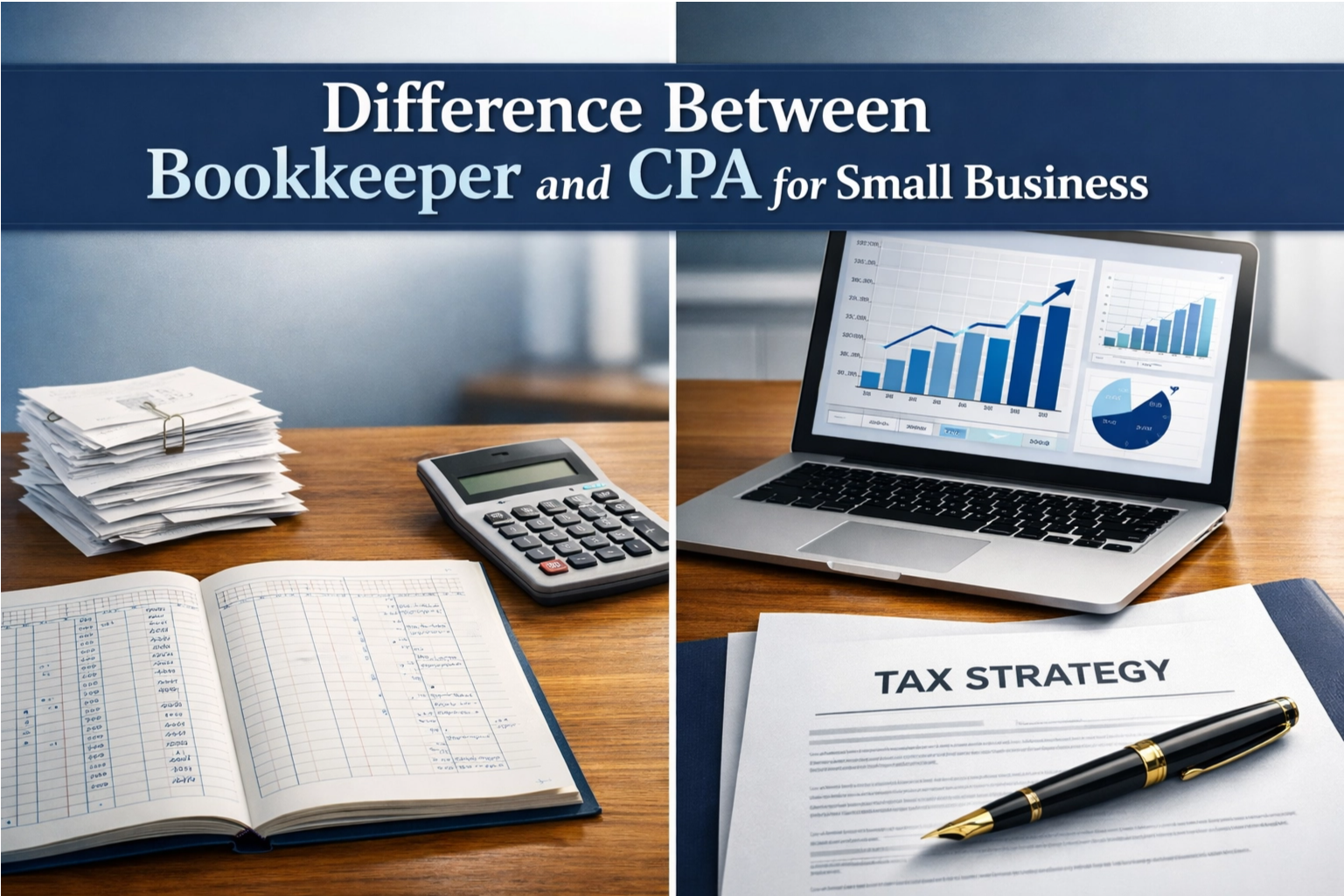
If you’re running or managing a growing company, understanding the difference between a bookkeeper and CPA for small business is crucial. Many business owners mistakenly assume these two roles perform the same function, but they serve very different purposes, especially when it comes to tax planning, compliance, and long-term strategy.
Both bookkeeping and accounting are essential, but they operate at different levels within the business’s financial structure. A bookkeeper handles day-to-day transaction recording, while a CPA interprets those records to help shape business strategy. Hiring the right professional at the right time can protect cash flow, reduce audit risk, and minimize your tax liability.
This guide breaks down the difference between a bookkeeper and CPA for small business owners, when you need each one, and how they work together to support business growth.
What Does a Bookkeeper Do for a Small Business
A bookkeeper is responsible for maintaining and organizing the daily financial transactions of a business. Their primary role is to ensure that all transactions whether income, expenses, or payments are properly recorded and categorized. This work lays the foundation for more advanced financial analysis and decision-making.
Core responsibilities of a bookkeeper typically include:
- Recording income and expenses: Ensuring that all sources of income and any outgoing expenses are accurately logged.
- Categorizing transactions: Organizing every transaction into the appropriate categories such as operational expenses, revenue, liabilities, or equity.
- Reconciling bank and credit card accounts: Ensuring that the company’s bank account records match the company’s financial records and resolving discrepancies.
- Managing accounts payable and receivable: Tracking bills to be paid (accounts payable) and money owed by clients (accounts receivable).
- Processing payroll entries: Managing employee wages and benefits, ensuring accurate payroll calculations.
- Maintaining the general ledger: Recording all of the company’s financial transactions in a systematic way.
- Generating basic financial reports: These include simple financial documents like profit and loss statements, balance sheets, and cash flow reports.
Bookkeeping answers the question: What happened financially in the business? It provides the clean, organized financial records that are essential for other more strategic business activities.
However, bookkeeping is mostly historical; it records past activities rather than influencing future actions.
What Does a CPA Do for a Small Business?
A CPA (Certified Public Accountant) offers more advanced financial analysis and strategic advice. They build on the work of the bookkeeper by interpreting the data, identifying opportunities, and planning strategies for the future. While a bookkeeper ensures accurate records, a CPA uses those records to help guide decisions that impact the business’s financial health, compliance, and profitability.
Services provided by a CPA often include:
- Tax preparation and filing: Ensuring that business tax returns are completed, filed on time, and in full compliance with tax laws.
- Tax planning strategies: Helping businesses develop strategies to minimize tax liabilities in the short and long term.
- Entity selection and restructuring: Recommending the best business structure (LLC, S-corp, etc.) based on tax efficiency and liability protection.
- IRS representation: If your business faces an audit or IRS notice, a CPA can represent your interests.
- Financial statement analysis: Analyzing profit margins, cash flow, and overall business performance.
- Audit and review services: Helping with financial audits to ensure compliance and transparency.
- Cash flow forecasting: Creating projections to ensure the business has enough liquidity to meet its needs.
- Succession and exit planning: Advising on the best approaches to selling or passing on the business.
Unlike bookkeepers, CPAs are licensed professionals who have passed a comprehensive exam and maintain certification through ongoing education. A CPA doesn’t just maintain the books they guide the business forward, ensuring that financial decisions align with long-term goals.
Key Differences Between a Bookkeeper and CPA for Small Business
The key differences between a bookkeeper and CPA for small business operations can be summarized across three areas: education and licensing, scope of services, and strategic impact.
1. Education and Licensing
- Bookkeeper
- No formal state licensing is required.
- Certifications such as Certified Bookkeeper may be earned, but these are not mandatory.
- Focus is on transactional accuracy and maintaining organized records.
- No formal state licensing is required.
- CPA
- State-licensed professionals who must meet stringent educational and work experience requirements.
- Certified Public Accountants (CPAs) are subject to ongoing continuing education to stay current with tax laws and accounting principles.
- CPAs operate under strict ethical guidelines and professional standards.
- State-licensed professionals who must meet stringent educational and work experience requirements.
While bookkeepers provide a solid foundation of financial data, CPAs ensure that this data is strategically used to enhance profitability, compliance, and tax efficiency.
2. Scope of Services
- Bookkeeper
- Data entry and transaction categorization
- Account reconciliation, payroll management, and basic reporting
- Monthly reports that give an overview of the business’s financial status
- Data entry and transaction categorization
- CPA
- Tax strategy and planning for the business and owners
- Audit representation, compliance guidance, and more complex financial analysis
- Multi-state tax planning, entity structure planning, and optimizing tax obligations for owners
- Proactive financial advice for long-term growth and profitability
- Tax strategy and planning for the business and owners
Bookkeeping focuses on accuracy and organization, while accounting at the CPA level focuses on interpreting that data and using it to develop business strategies.
3. Strategic Impact
- Bookkeeper
- Maintains accurate, up-to-date financial records.
- Ensures operational efficiency through organized records and regular reconciliations.
- Maintains accurate, up-to-date financial records.
- CPA
- Uses financial data to make informed decisions about tax reduction, entity structure, and financial growth strategies.
- Helps reduce tax liability and minimize financial risks through careful planning.
- Develops business strategies based on financial data, ensuring profitability and cash flow management.
- Uses financial data to make informed decisions about tax reduction, entity structure, and financial growth strategies.
While bookkeeping is essential to day-to-day operations, accounting provides the tools and strategies to build a successful, sustainable business.
Why Small Businesses Need Both a Bookkeeper and CPA
Many small business owners ask whether they need a bookkeeper or CPA. In reality, most growing businesses need both.
Here’s why:
- Accurate bookkeeping supports tax compliance: Clean, organized records make tax time much easier and help ensure tax filings are accurate.
- Clean financials allow proactive tax planning: With organized financial records, a CPA can identify tax-saving opportunities.
- Monthly reporting supports quarterly projections: Ongoing bookkeeping allows for timely reporting, which is essential for making informed financial decisions.
- Organized records reduce audit risk: When your financial records are organized and up to date, you minimize the likelihood of audits or IRS scrutiny.
Without a bookkeeper, your tax filings would be based on incomplete or disorganized data. Without a CPA, you’re missing the strategic insight and tax planning that could significantly reduce your tax burden.
When Do You Need a Bookkeeper
Small businesses typically need a bookkeeper when:
- You are behind on reconciling accounts: If monthly bank and credit card account reconciliations are not happening on time, it’s time to bring in a bookkeeper.
- Your financial reports are inaccurate: Inconsistent or inaccurate reports make it difficult to make informed business decisions.
- You don’t know your monthly profit: Without up-to-date records, it’s challenging to determine if the business is financially stable.
- You’re mixing personal and business expenses: A bookkeeper will help keep personal finances separate from business transactions, which is vital for tax time.
- Tax time feels chaotic: If tax season feels like a scramble, it’s a sign that you need more organized bookkeeping support.
As businesses grow, especially when monthly revenue becomes consistent, it’s vital to have professional bookkeeping to maintain financial clarity and ensure that the tax preparation process goes smoothly.
When Do You Need a CPA
You likely need a CPA if:
- Your business is consistently profitable: If your profits are growing and you are unsure how to structure the business for tax optimization, a CPA can help.
- Your tax liability is increasing: As your business grows, a CPA can guide you through the best tax strategies to minimize liability.
- You are expanding into new states: A CPA can help with multi-state filings, making sure you comply with each state’s tax laws.
- You are considering a business restructure: If you’re thinking about forming an LLC or electing an S-corp, a CPA can help guide you through the best option for your business.
- You received an IRS notice: A CPA can represent your business before the IRS if there are issues with tax filings.
- You are preparing to sell your business: If you are planning to sell, a CPA can help with business valuation and tax implications.
Once your business starts generating consistent profit or experiencing complex tax situations, tax planning and financial strategy will become necessary, and a CPA is crucial in those decisions.
Tax Planning Is the Biggest Difference
The biggest difference between a bookkeeper and CPA for small business owners is tax planning.
A bookkeeper records income and expenses, but only a CPA can take that data and develop strategies to:
- Reduce taxable income through planning and structuring
- Maximize deductions and identify tax credits that are often missed
- Optimize retirement contributions to reduce tax burden
- Structure owner compensation in a way that minimizes tax liabilities
- Manage estimated payments for taxes
Proper tax planning can save businesses thousands, sometimes tens of thousands, of dollars annually money that would otherwise be lost to unnecessary taxes.
Real World Example
Imagine a small business generating $750,000 in revenue with $250,000 in profit. The bookkeeper ensures that:
- Transactions are categorized correctly
- Payroll is processed timely
- Monthly reports are accurate
The CPA, however, can identify areas for strategic improvement, such as:
- S corporation election to reduce self-employment taxes
- Optimizing reasonable compensation for the owner
- Structuring retirement plan contributions
- Applying Section 179 deductions on equipment purchases
- Projecting quarterly tax payments accurately
In this scenario, tax savings alone could exceed $20,000 annually, thanks to proactive planning by the CPA. This is the critical gap between what bookkeeping provides and what a CPA delivers for business optimization.
Cost Comparison Between a Bookkeeper and CPA
The cost of bookkeeping services generally depends on factors such as the volume of transactions, payroll complexity, and the level of reporting required. Bookkeepers typically charge on a monthly basis to handle day-to-day financial activities such as recording transactions, reconciling accounts, and generating basic financial reports. Because bookkeepers focus on the foundational work of organizing financial records, their services are often more affordable compared to CPAs. For small businesses with relatively straightforward financial structures, bookkeeping services can be an essential yet cost-effective solution to maintain accuracy in financial reporting.
However, bookkeeping costs can vary widely. If a business has many transactions, complex payroll, or requires more advanced financial reporting, the cost of bookkeeping may increase. Similarly, small businesses with seasonal fluctuations or high volume (e.g., retail or eCommerce) may need a bookkeeper to work more hours, further raising the cost.
On the other hand, CPA services are generally more expensive due to their broader scope, particularly when it comes to tax strategy, financial analysis, and business advisory. CPAs do more than just prepare financial statements; they provide high-level services like tax planning, entity restructuring advice, audit representation, and in-depth financial forecasting. The cost of CPA services is justified by the value they bring through their expertise in helping businesses minimize taxes, manage cash flow, and make informed decisions that promote long-term growth. The investment in CPA services often pays for itself through proactive tax strategies that reduce overall tax liabilities and optimize profitability.
When comparing costs, it’s important to consider the value of each service. While bookkeepers focus on transactional accuracy, CPAs add strategic value by using that data to enhance financial decision-making and tax efficiency. Thus, the question shouldn’t just be about cost, but about the value that each service brings to your business’s financial health.
Can a Bookkeeper Replace a CPA
In most cases, no, a bookkeeper cannot replace a CPA. A bookkeeper’s primary responsibility is to ensure that financial transactions are accurately recorded and properly categorized. This includes maintaining the general ledger, processing payroll, reconciling accounts, and producing basic reports like profit and loss statements. However, a bookkeeper cannot provide the in-depth tax strategy or financial analysis that a CPA does.
A CPA is a licensed professional with specialized expertise in tax planning, compliance, and advanced financial strategies. They can represent a business before the IRS, help reduce tax liability, and provide audit defense. CPAs also assist with complex business decisions, such as entity selection (e.g., deciding whether to structure as an LLC, S-corp, or C-corp), optimizing tax deductions, and forecasting future cash flow.
While some experienced bookkeepers may perform basic financial analysis, the strategic level of advice and tax planning that CPAs provide is irreplaceable. Bookkeepers are essential for managing the day-to-day operations, but CPAs ensure that the financial decisions being made are strategic and compliant with regulations, ultimately safeguarding the business from financial risks.
Thus, bookkeepers and CPAs complement each other, and businesses often need both to maintain accurate records and achieve strategic growth.
How Bookkeepers and CPAs Should Work Together
For small businesses to thrive, it’s crucial to integrate both bookkeeping and CPA services effectively. These two roles, while distinct, should work in tandem to ensure accurate financial reporting and strategic planning. Here’s how they should ideally collaborate:
- Bookkeeper’s role: The bookkeeper is responsible for the day-to-day financial activities. This includes accurately recording all financial transactions, reconciling accounts, maintaining ledgers, and producing financial reports such as income statements and balance sheets. The bookkeeper ensures that all data is organized and easily accessible.
- CPA’s role: Once the bookkeeping is completed, the CPA reviews the financial reports generated by the bookkeeper to provide tax planning, financial analysis, and business advisory. CPAs analyze profitability, guide on tax-saving strategies, evaluate entity structure for tax optimization, and provide insights for strategic growth.
- Monthly/Quarterly Collaboration: The bookkeeper and CPA should meet regularly at least quarterly to review the business’s financial situation. The bookkeeper provides updated reports, while the CPA advises on tax strategies, financial forecasting, and long-term planning. This collaboration ensures that tax-saving opportunities are identified early and that the business is on track financially.
- Year-End Tax Planning: At year-end, the bookkeeper ensures all transactions are reconciled and financial reports are prepared for the CPA’s review. The CPA uses this data to finalize the business’s tax returns, make recommendations for future financial strategies, and plan for the next year’s tax season.
This integrated approach creates a comprehensive financial system for the business, ensuring both accuracy and strategy. Having both professionals working in tandem ensures the business stays compliant, optimizes its tax position, and has a clear financial strategy for growth.
Common Mistakes Small Business Owners Make
When it comes to managing both bookkeeping and CPA services, small business owners often make several key mistakes that can impact their financial health. Below are common mistakes to avoid:
- Waiting until tax season to involve a CPA: Many business owners wait until the last minute to consult a CPA, but tax planning should be a year-round process. Waiting until tax season can limit opportunities for tax savings and increase the risk of missing deductions or making mistakes on tax returns.
- Relying solely on bookkeeping software: While accounting software can assist with transaction recording, it cannot replace the strategic advice that a CPA offers. Bookkeeping software does not provide tax optimization or the financial guidance needed to make key business decisions.
- Failing to run tax projections: Not running tax projections throughout the year can lead to surprises when tax season arrives. Small businesses should check quarterly projections to avoid unexpected tax bills, optimize deductions, and structure payments effectively.
- Not revisiting entity structure as profits grow: Many small business owners keep the same entity structure (e.g., LLC, Sole Proprietor) for years, even when their profits grow. Revisiting the entity structure can have significant tax advantages, and a CPA can help identify the best structure as the business evolves.
- Choosing service based solely on cost: While it’s tempting to focus on price, businesses should prioritize expertise and experience. Choosing a service provider based on cost alone could result in missed opportunities or costly mistakes that far outweigh any upfront savings.
These mistakes often stem from a lack of understanding of the important roles that bookkeeping and accounting play in a business. By taking a proactive approach to bookkeeping and tax planning, small business owners can avoid many common pitfalls and improve their financial position.
Do You Need a CPA if You Have a Bookkeeper
Yes, if your business is profitable or expanding, you need a CPA. While a bookkeeper ensures accuracy and organizes daily financial data, a CPA adds strategic value by using that data to optimize tax efficiency, reduce liabilities, and plan for growth.
Having both a bookkeeper and CPA ensures that you are not only keeping accurate records, but also making informed financial decisions. A CPA is crucial when your business begins moving beyond the start-up phase and into a sustained growth stage. They will help with tax planning, investment strategy, entity structure, and other complex financial matters that directly impact your bottom line.
Work With a CPA Who Understands Small Business
Our firm specializes in supporting small businesses with bookkeeping services that seamlessly integrate with proactive tax planning. We work closely with you to:
- Coordinate bookkeeping and tax planning
- Optimize your entity structure
- Implement business tax planning strategies
- Run proactive tax projections
- Reduce overall tax liability
Understanding the difference between bookkeeping and CPA services is the first step. Implementing both roles effectively is what drives long-term financial success for your business.
Frequently Asked Questions
What is the difference between a bookkeeper and CPA for small business
A bookkeeper records financial transactions and maintains accurate records. A CPA provides tax planning, compliance oversight, and financial strategy.
Do I need both a bookkeeper and CPA for my small business
Most growing businesses benefit from having both. The bookkeeper manages daily financial data while the CPA uses that information to implement tax strategies.
Can a bookkeeper file business taxes
Some bookkeepers prepare basic returns, but they are not licensed CPAs and generally do not provide advanced tax planning or IRS representation.
When should a small business hire a CPA
You should hire a CPA once your business becomes consistently profitable, expands operations, or faces complex tax situations.
Is a CPA more expensive than a bookkeeper
CPA services typically cost more due to licensing, expertise, and strategic advisory services. However, proactive planning often results in tax savings that outweigh the fees.
Can a CPA do bookkeeping
Some CPA firms offer bookkeeping services, but many focus on higher level advisory and tax strategy.
Does a small business need a CPA if using accounting software
Yes. Accounting software records transactions but does not provide strategic tax planning or compliance guidance.
What services does a CPA provide beyond tax filing
CPAs provide tax planning, entity structuring, audit representation, cash flow forecasting, and long term financial advisory.